Sign in. It’s quick, free and it’s up to you.
An account is an optional way to support the work we do. Find out more.
Sign in. It’s quick, free and it’s up to you.
An account is an optional way to support the work we do. Find out more.
A WOMAN BANNED by Australian authorities from giving health advice encouraged cancer sufferers to spurn chemotherapy at an alternative medicine event held near Drogheda last Thursday.
Barbara O’Neill was permanently banned by the New South Wales Health Care Complaints Commission in 2019 from “providing any health services”, either paid or voluntarily, including giving advice.
“The misinformation has huge potential to have a detrimental effect on the health of individuals as Mrs O’Neill discourages mainstream treatment for cancer, antibiotics and vaccinations,” its finding reads.
“The Commission is satisfied that Mrs O’Neill poses a risk to the health or safety of members of the public.”
Since her ban, O’Neill has travelled the world, giving lectures that could see her imprisoned or fined for breaking the prohibition order in New South Wales.
Ahead of this latest series of lectures (which are not her first in Ireland), health and science experts had published an open letter to the venues hosting her.
“O’Neill consistently urges patients to abandon effective therapies like chemotherapy, scaremongering patients about medical treatment and engendering mistrust in healthcare teams,” the letter, signed by more than a dozen doctors, reads.
On Thursday, The Journal attended one of her seminars in person to see if their concerns transpired.
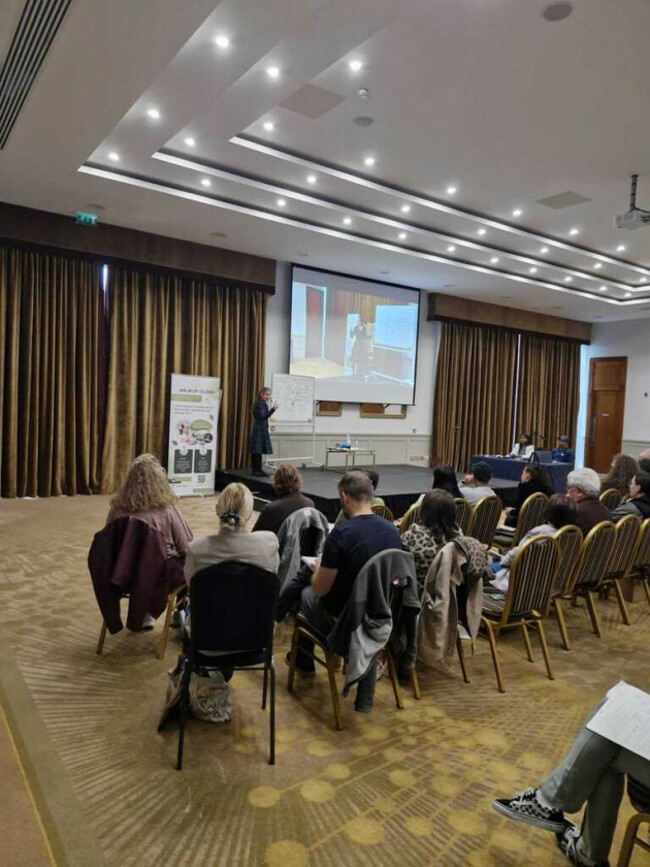
The event was the last day of O’Neill’s “Journey of Healing” seminar. Held at a hotel located on the border between Meath and Dublin, it was billed as “an unforgettable three-day health and wellness experience with renowned health educator Barbara O’Neill”.
“Discover practical, life-changing principles for healing naturally and learning how simple lifestyle choices can transform your health—body, mind, and soul,” a post on O’Neill’s Facebook page read.
Previous days had included modules on sexual health and the “true cause of disease”, but O’Neill waited until the final day of the course to broach the topic that has brought her notoriety: cancer.
On arrival, attendees coming into the venue could see a devil, complete with red horns and flames, displayed on a billboard advertising a separate comedy gig at the same hotel later that month.
Different biblical imagery continued inside.
The event was hosted by a religious group promoting what they called “Bible based health principles”, and a stack of bibles was left on a desk near the entrance for attendees to take.
Inside the hall, O’Neill stepped onstage in a midnight blue dress and black stockings. Her thick grey hair was held in a loose ponytail, revealing the beaming face of a kindly grandmother.
She spoke in a gentle, lulling Australian accent. Soon, a list of organs was scrawled on the whiteboard onstage beside her: tongue; liver; lungs; skin; kidneys; colon.
As she wrote, O’Neill recommended salves, herbs and poultices for various conditions and effects.
The audience, about 400 strong, were mostly well-dressed women, aged between 20 and 60. There was a smattering of men.
O’Neill’s first talk, nominally on the liver, was about detoxifying the body.
Public health doctors often question the idea of “detoxes”, which are promoted by gimmicky supplements with unproven health effects.
They argue that the body detoxes itself, largely through the liver.
“The whole idea of a detox diet is a super fad,” dietician Sarah Noone wrote for the Irish Heart Foundation. “There is no evidence that toxins even build up in our bodies.”
Nevertheless, large parts of O’Neill’s talk consisted of mainstream medical truisms and could easily have been lifted from a lecture to first-year medical students.
Chains of chemical pathways were scribbled next to the list of organs on the whiteboard.
Some of O’Neill’s prescriptions could have been taken from a generic HSE page: sleep; exercise; eat more fibre and less sugar; stay hydrated.
At one point, she echoed the critics of alternative medicine, saying the liver will detox the body in the right circumstances.
Though, according to O’Neill, the right circumstances for the liver to detox the body are when a person obeys a strict diet of juice and protein shakes, along with a regimen of saunas.
She advised that if your tongue tastes bad or if you cough up each morning, they are good signs. It means that the detox is working.
Other snippets were more concerning.
“I was very happy whenever my babies got fevers,” she told the crowd.
O’Neill claimed this was because, unlike the overwhelming consensus in modern medicine, she believed that most common infectious diseases are caused by toxins, not microbes, which she said appear in sick people because they are there to help clear out the body.
She says a person without toxins can’t catch a cold.
This view of disease is probably why there was only one mention of vaccines in Thursday’s talks: she outlined how audience members who received vaccines can detox themselves from them.
One does not need to detox from vaccines. The germ theory of disease has been established for centuries.
Fever was also presented by O’Neill as just another way a person could detox.
“When all the rubbish is burnt up, the fire goes out,” she told the audience.
O’Neill also said that extra benefits occur when a person’s body temperature hits between 43 and 45 degrees Celsius, though she also admitted she never bothered to check her own children’s temperatures.
A fever of 45 degrees is considered a severe medical emergency in anyone, particularly children, even when there are no other symptoms. The HSE recommends contacting a doctor at 40 degrees.
O’Neill made no mention of the risks when a person’s body temperature gets that high, which include brain damage or death.
“Fever is your friend,” she told the crowd.
Some in attendance had children with them. Others were visibly pregnant.
Outside the conference hall, a corridor featured ads for a “parasite and gut cleanse”, among other detoxes on sale.
At the end of the hall, juice was sold for €8 a bottle with about a hundred impressive, if sufficiently vague, health claims, e.g. “May lower cholesterol”.
When The Journal bought a €70 ticket for a one-day pass to O’Neill’s lecture, a popup appeared onscreen offering to add some “wild yam cream” to the order, at a cost of an additional €60.
O’Neill generally recommends listeners to rub this on their skin to balance hormones, or to treat depression and thyroid problems, but, in a later lecture, O’Neill cited this cream as part of a cancer treatment.
Aside from the aforementioned bibles, which were given out freely, O’Neill’s own modestly sized book was also on sale for €50.
“Sterling,” the seller said, as a woman tapped her card to pay.
At just €15, a 50-page booklet in startling red was a comparative steal; it was called The Assassination of Barbara O’Neill.
Its blurb asked: “How could a 66-year-old grandmother, who gave her life to helping people with their health, become the subject of a malicious smear campaign which resulted in her being classified as a serious threat to public health in Australia?”
After a break, the audience went back to hear O’Neill’s views on cancer.
During her talks, O’Neill did not shy away from the controversy surrounding her.
She referenced her ban by Australian health authorities, though her version of the story claimed they were part of a corrupt medical establishment.
As part of a story about being arrested in Qatar, she ironically described herself as “a threat to public safety” to laughs in the audience.
She said that journalists often focus on her claim that cancer is a fungus, which she says is only true sometimes.
At another time, she proclaims “cancer is a yeast”.
Cancer is definitively not a yeast; it is a disease caused by the uncontrolled growth of a person’s own cells.
If there was a central message to the talk, it was that O’Neill hates chemotherapy (and, to a lesser extent, mammograms).
Much of what she said might have been familiar to patients: chemotherapy works by killing cells and is often extremely unpleasant, making the patient feel far sicker during the course.
Unexpectedly, she conceded chemotherapy’s main benefit: it saves lives. She did not dwell on that aspect.
Instead, she told the story of a woman who was so debilitated by chemotherapy that she couldn’t walk.
O’Neill says the woman died, but was then revived. Following the woman’s near-death experience, she decided to treat her disease with herbs.
In inspirational tones, O’Neill went on to tell the crowd that the woman hid her change of course from her family, because she knew they would have tried to get her to go back to chemotherapy.
O’Neill also told an inspirational story of a different woman with no white blood cells who came to her retreat, and by the end of a week was back to normal.
“I’ve helped many people conquer cancer,” O’Neill says.
She said that the truth about cancer — that it can be cured with herbs and diet — was suppressed when “the Rockefellers and the Rothschilds came along”, referring to two wealthy dynasties.
The latter in particular has been the target of many conspiracy theories.
She told another inspirational story about a doctor who discovered a new cure for serious diseases like cancer, but lost his licence to practise.
“Whenever you see that, do you think: they must be good?” she asked the crowd to murmurs of agreement.
Later, O’Neill mentioned why the doctor lost his licence: his treatment killed a patient. She considered this unimportant.
Many of O’Neill’s anecdotes on the day began the same way.
“A man came up to me and said, ‘Barbara, I was sick…’,” she recalled.
The person then supposedly tells O’Neill they had some horrific disease that modern medicine couldn’t help, but that by going to one of her retreats or following her prescriptions, they had been cured.
She does not cite research papers, statistics or clinical trials.
Anecdotes about the miraculous recovery of patients were the only evidence she presented.
The story of a woman who died taking chemotherapy drew gasps from the crowd, before O’Neill revealed that woman was still alive and healthy.
Conversely, the death of a patient directly from an untested treatment was dismissed.
When the doctor who administered it was stripped of his licence, it was implied to be a sign that the treatment must work.
In some stories, it was unclear if there were medical issues to begin with.
O’Neill spoke of a Vietnam war veteran who was afraid to lose weight. He believed it might release chemicals from Agent Orange stored in his fat cells.
She put him on her detox course. When, months later, he lost weight with apparently no toxic effects, O’Neill counted this a victory for her system of medicine.
O’Neill mentioned that critics have questioned whether the examples she gives exist, but there is a more glaring issue. Even if the examples are real, they are entirely self-selecting.
She’s unlikely to hear from people who try her treatments and get no benefit.
Some simply won’t pay for an audience with O’Neill just so they can tell her that her treatments don’t work.
Others might be unable to speak to her at all, including those who forgo mammograms or chemotherapy on her advice.
Nevertheless, through her select examples, O’Neill painted a picture of the body as a self-healing gift from God, occasionally thrown out of balance, but often very much within our control.
Disease was held up as the result of toxins (she ranted against polyester, as an example) that generally could be cured by the right herbs, or saunas, or body wraps.
The last lecture of the day related to mental health, at least peripherally.
There were some religious references throughout the lectures, but initially these were sporadic.
“All I am is a mouthpiece for the great god of heaven’s natural remedies,” O’Neill said at one point, a revelation that met with a hum of approval.
During the last lecture, almost every point O’Neill made was accompanied by at least one reference to scripture.
References to mainstream science became rarer and were sometimes disparaging; on group therapy, O’Neill said that people should just get over their trauma and move on.
She said that this echoed Jesus’ teaching on forgiveness, which in turn has been confirmed by modern understandings of neurology.
O’Neill also claimed that memorising the Bible is scientifically proven to be one of the best things you can do for your brain.
She said God speaks to people through their pre-frontal cortex, and that neuroplasticity — the brain’s ability to rewire itself — is mentioned in the Bible.
As evidence, she quoted Proverbs 13:20: “Whoever walks with the wise becomes wise, but the companion of fools will suffer harm.”
O’Neill told the audience that she intends to return to Ireland next September.
One wonders what her words will have inspired by then.
The Journal’s FactCheck is a signatory to the International Fact-Checking Network’s Code of Principles. You can read it here. For information on how FactCheck works, what the verdicts mean, and how you can take part, check out our Reader’s Guide here. You can read about the team of editors and reporters who work on the factchecks here.

To embed this post, copy the code below on your site










have your say