We need your help now

Support from readers like you keeps The Journal open.

You are visiting us because we have something you value. Independent, unbiased news that tells the truth. Advertising revenue goes some way to support our mission, but this year it has not been enough.

If you've seen value in our reporting, please contribute what you can, so we can continue to produce accurate and meaningful journalism. For everyone who needs it.

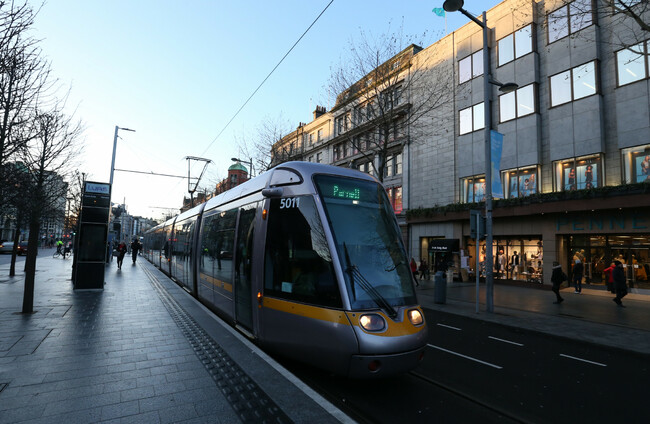
The Luas Cross City in Dublin, which began running eight years ago RollingNews.ie

Cork's Luas is ambitious and not without problems, but there's no excuse to keep pushing it out

The city recently ranked as one of the worst in the world when it comes to road traffic.

LONDON. TORONTO. ROME.

These global cities all share one key trait: they don’t have a congestion problem as bad as Cork, a city recently ranked as one of the worst in the world when it comes to road traffic.

While one could take issue with ranking Cork below the aforementioned trio, few Corkonians would likely argue with the takeaway – that driving around the city centre is a slow and frustrating experience.

The city is a small one by European standards, yet crossing it during rush hour can be nightmarish. And it has ambitious aims to grow its population by about 50% over the next 20 years.

To achieve this while allowing people to move around the city in a semi-reasonable timeframe, Cork will need better transport infrastructure.

This is why the unveiling of the route of Cork’s light rail line – its equivalent of a Luas – was so welcome earlier this week.

The proposed 18km long track will run from Ballincollig, west of the city centre, to Mahon Point in the east.

Among the key points that will be connected are Cork University Hospital, UCC, Cork city centre and the Cork Docklands.

As the dust settles on the announcement, there are a few key takeaways.

The thrust of the project and the route is largely good, but there are also significant issues, particularly around capacity, journey times and how trams will interact with normal traffic.

If these issues are addressed as effectively as possible, in as short a time as possible, the project should progress.

Let’s go over these issues one at a time.

The Good

A significant amount of consideration appears to have gone into the proposed route.

Connectivity was obviously a major factor; with MTU and UCC along the line, tens of thousands of students living in Cork could have a reliable way of getting into university.

The same goes for hospital staff at CUH and people working living in the surrounding estates who work in the city centre.

This is all to say that the route that was selected largely makes sense, and would be useful for tens of thousands of people every day.

It could pass through some lower density residential areas, and given the expected population growth of Cork, it’s likely many of these areas will need better transport in the coming decade or so.

A Cork Luas would also allow building in areas further away from the city, while reducing traffic and pollution from vehicle emissions.

Cost estimates for the project are fuzzy at best right now, particularly as the proposed route could still change. But figures of about €2 billion to €3 billion have been thrown about.

Although that may sound like a high price tag because the two Luas lines in Dublin cost under €1 billion, they were both built about 20 years ago.

The sooner projects like this get built, the cheaper they tend to be. We know from the Dublin Luas that light rail tends to be cost-effective in the long run, so the argument for moving quickly on the Cork Luas from a cost-perspective is strong.

Problems

But one of the biggest early complaints about the proposal has been that the Cork Luas line will miss several key population centres.

The one that stands out is Douglas, a suburb to the south of the city which is home to about 30,000 people.

The suggestion that Douglas could be included in a future expansion will likely come as cold comfort, given how long the Dublin Luas waited for a new line – there were 13 years between the opening of the Red and Green lines in 2004 and the Luas Cross City in 2017.

It’s unfortunate that areas such as this will not be covered under the proposal, but perhaps the bigger issue is the travel times for the stops that are included.

The likes of the Cork Commuter Coalition have highlighted that trams would have to share road space with cars along large chunks of the line.

The downside is that, along these sections, a tram can get stuck in traffic as easily as a bus.

This issue also bleeds into frequency (how often trams run) and capacity (how many people can they move around per hour). In a good transport system, those numbers should both be as high as possible.

That is what has led to concerns that the frequency and capacity estimates for Cork Luas have both been significantly downgraded compared to a proposal published in 2020.

It’s true the 2020 estimates were probably on the optimistic side.

But the new figures estimate that the Cork trams would only be able to move about a quarter of the people that the Dublin Luas does.

This is likely because the Cork line has to share much more road space with cars compared to the trams in the capital.

Timelines

Despite these concerns, the Cork Luas should still go ahead.

The city’s already awful congestion and rising population means it desperately needs more reliable public transport options.

Ensuring that more new housing stays clustered around Luas stops would also help limit urban sprawl. The sooner this can be delivered, the better.

But things on that issue, unfortunately, don’t bode well.

The project has already been allowed to drift for years. As mentioned, a proposal for light rail in Cork was put forward in 2019. It’s taken six years just to get a proposed route.

And even then, there’s been no commitment.

Take the statement from Micheál Martin during the week, when asked when the Cork Luas will be delivered.

“I want to accelerate the timeline. I’m wary of other projects in the past and if you give a specific timeline, people are back onto you in terms of meeting those times,” the Taoiseach said.

It’s not exactly confidence-inspiring.

His comments essentially boil down to the argument that if the Government gives people a timeline, people will expect them to deliver the Cork Luas in that time.

One might respond by saying that’s the point, and that this is how development projects are meant to work.

As we’ve seen, timelines can (and often do) drift. But giving a delivery date at least somewhat focuses the mind.

We can at what has already happened with the Cork Luas in the absence of one – the project has remained in a state of flux for six years.

To be fair to the Taoiseach, he isn’t the one who will spearhead the project. That’ll be on state bodies such as Transport Infrastructure Ireland, with Cork councillors and TDs also needing to take on responsibility to bring momentum.

But someone has to be willing to take responsibility, and aggressive timelines should be set.

Labour and Sinn Féin have both said construction work should start by 2030. That should really be the minimum aim.

There will now be a few rounds of consultation before a preferred route is selected. Then there’ll be a design stage, involving a detailed business case examination. Afterwards, a planning application [also called a ‘railway order’] will be submitted.

Then, planning regulators will have to decide on the application, before a tender process is carried out, before, finally, work can start. This is well laid out on the Cork Luas website.

Normally in Ireland, this entire process can take years.

Just have a look at Dublin’s MetroLink. Originally set to be delivered by 2027, it was then pushed back to “some time” after 2031, then to 2034. It will likely move back again.

This has all been way too slow.

From where the Cork Luas is at now, the aim should be to select a final route and submit a planning application by the end of 2027 at the latest.

There are issues of course, and the likes of what to do with Douglas, or how road space will be shared with cars, stick out.

But the timeline to deal with these problems doesn’t have to stretch into the 2030s.

Cork’s Luas has already gone six years with very little to show for it. By the end of the next five, shovels should be in the ground.

Readers like you are keeping these stories free for everyone...
A mix of advertising and supporting contributions helps keep paywalls away from valuable information like this article. Over 5,000 readers like you have already stepped up and support us with a monthly payment or a once-off donation.

Close
29 Comments
This is YOUR comments community. Stay civil, stay constructive, stay on topic. Please familiarise yourself with our comments policy here before taking part.
Leave a Comment
    Submit a report
    Please help us understand how this comment violates our community guidelines.
    Thank you for the feedback
    Your feedback has been sent to our team for review.

    Leave a commentcancel

     
    JournalTv
    News in 60 seconds