Sign in. It’s quick, free and it’s up to you.
An account is an optional way to support the work we do. Find out more.
Sign in. It’s quick, free and it’s up to you.
An account is an optional way to support the work we do. Find out more.
LAST UPDATE | 23 hrs ago

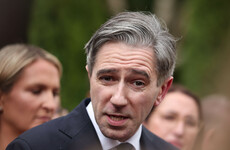
TÁNAISTE SIMON HARRIS has said Ireland’s military non-alignment “won’t change”, but described closer European security cooperation as “a good thing” following proposals that would allow any EU country to trigger emergency talks over security threats.
Speaking in Strasbourg today, Harris said Ireland was not immune from cyber, maritime or drone threats, although he stressed that the government would need to examine the details of the proposals before taking a position.
His comments came after European Commission President Ursula von der Leyen proposed a new security mechanism that would allow Ireland or any other member state to convene all EU countries in response to incidents such as sabotage, cyberattacks or drone incursions.
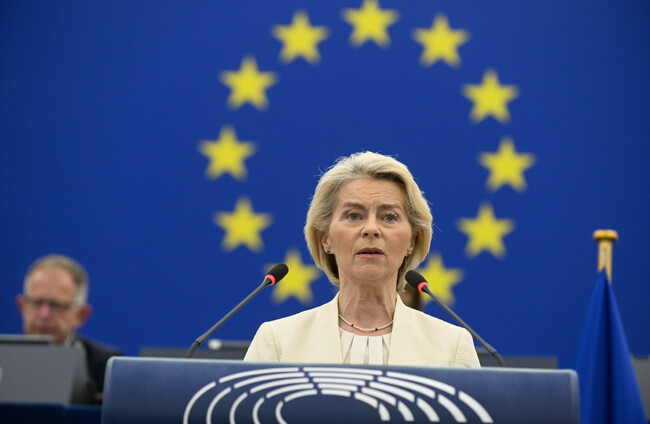
Delivering her annual State of the Union address to MEPs this morning, von der Leyen called for a European Article 4, or Emergency Security Protocol, alongside plans for a European Security Council involving countries outside the bloc.
“Cyberattacks and sabotage, arson and drone incursions. They are ramping up every day,” she said.
“So, as the threat level climbs, so must Europe’s preparedness.”
Under the proposed mechanism, any member state could trigger consultations involving the entire bloc to coordinate a response, deter further escalation and mitigate the impact of a security incident.
“When triggered by one Member State, all Member States would convene. To coordinate a European response. To deter further escalation. And to mitigate the impact,” von der Leyen said.
The mechanism would complement Nato’s Article 4 consultation process, rather than create an automatic collective-defence obligation.
EU's von der Leyen:
— Clash Report (@clashreport) September 16, 2026
Our doctrine, our institutions, and our decision-making have not kept pace with the new reality.
Our systems are made for a different world. Europe needs its own counter-hybrid playbook.
We urgently need a consensus on how to respond to certain incidents.… pic.twitter.com/E7KKP2vYdB
Von der Leyen also proposed a European Security Council involving partners including Canada, Norway, Ukraine and the United Kingdom.
“This is even more urgent now, given the nature and scale of the risks at play,” she said.
She also announced a European Instrument for Strategic Enablers to strengthen capabilities including air and missile defence, strategic transport, space and cybersecurity.
Responding to the proposals, Harris said he would need to discuss them with government colleagues.
“The first thing I’d say is I think the State of the Union speech today, delivered by President von der Leyen, was probably one of the most consequential and ambitious State of the Union speeches delivered in a very sustained period of time,” Harris said.
He said the address contained “some really big ideas” across several policy areas, but cautioned that further details would be needed.
“The devil is always in the detail. A State of the Union speech, in its nature, is high level. We’ve obviously got to see the detail.”
However, Harris said Ireland’s geographical position and military non-alignment did not protect it from security threats.
“Even a country like Ireland, on the geographic periphery of Europe, that is militarily unaligned and that won’t change, isn’t in any way immune from threats,” he said.
He cited cyber, maritime and drone threats, saying cooperation and information-sharing with European partners was positive.
“Being able to work together, exchange information, and we already do this in a number of areas at a European level, is a good thing,” he said.
Harris added that European citizens, including Irish people, would take “some level of comfort and reassurance” from the EU taking defence and security seriously.
Von der Leyen pledged further support for Ukraine ahead of a difficult winter, including assistance with energy supplies and air defences.
She outlined plans to jointly develop an affordable missile-defence system called Freyja with Ukraine and use remaining funds from the EU’s SAFE programme for projects with Ukrainian companies.
She also pledged to increase pressure on Russia by enforcing existing sanctions and closing loopholes.
Turning to the Middle East, she said the suffering in Gaza and settler violence in the West Bank had deeply affected Europeans.
“The Israeli government’s decision to advance the illegal E1 settlement project is unacceptable,” she said.
Von der Leyen acknowledged that EU member states had failed to agree on a unified response to measures she proposed last year.
“When Europe is divided, it cannot change the course of events.”
She said nearly €1 billion had been pledged through the Palestine Donor Group and Team Gaza Initiative to rebuild Gaza and support the Palestinian Authority.
The Commission President proposed a European Emergency Response Framework for exceptional migration pressures, including situations where large movements of people are deliberately engineered.
Referring to events at the Spanish enclave of Ceuta, she said: “Ceuta’s border is a European border. Because Ceuta is Spain. Ceuta is Europe. And Europe will be there for you.”
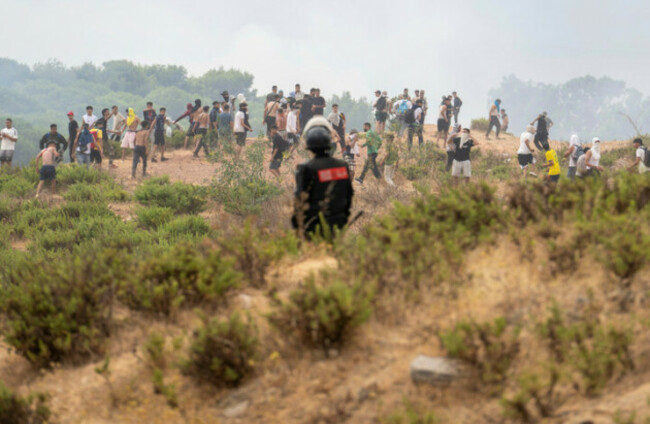
The framework would be activated only under strictly defined criteria and allow temporary, limited flexibility in standard procedures.
“We will always comply with our values and fundamental rights. But we will never compromise on protecting our borders,” she said.
She also called for stronger efforts to speed up returns through Frontex and announced a Mediterranean Youth Skills and Jobs initiative.
Ireland received a direct mention as von der Leyen warned about the effects of climate change.
“This summer was the summer of truth. Almost no part of our continent was spared,” she said.
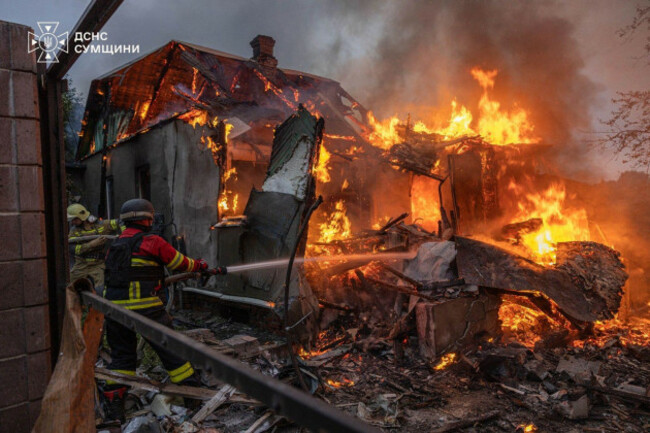
“Flames roared from the mountains of Ireland to the islands of Greece and Croatia.”
She said 660,000 hectares had burned across Europe and around 12 million tonnes of crops had been lost.
“These were the hottest summer months ever, but probably the coolest of the years to come,” she warned.
Von der Leyen announced plans for a climate resilience framework, a Climate Insurance Alliance and a European Heatwave Plan. Senior emergency responders have also been asked to develop proposals for a future European Firefighting Fleet.
Canadian Prime Minister Mark Carney was in the chamber as von der Leyen proposed opening the door to Canada becoming the EU’s first associate member.
She also outlined plans for an “Alliance for the Future” covering trade, defence, technology, energy and critical minerals.
“We want to bring the relationship with Canada to the highest level possible,” she said.
The proposal drew a standing ovation from MEPs.
Von der Leyen also announced that the Commission would propose an EU Kids Act tomorrow, setting out restrictions on children’s access to social media.
“No social media under the age of 13. No personal account under the age of 15,” she said.
Children aged 13 and 14 would be limited to parent-supervised accounts, while platforms would face safe-design obligations for users aged 15 to 17.
Addressing artificial intelligence, von der Leyen said Europe wanted to harness its benefits while managing the risks.
“But above all, we want AI with human agency,” she said.
She also pledged to defend women’s rights, declaring: “Women are here to stay. We will defend our rights.”
Additional reporting from AFP

To embed this post, copy the code below on your site







have your say