We need your help now

Support from readers like you keeps The Journal open.

You are visiting us because we have something you value. Independent, unbiased news that tells the truth. Advertising revenue goes some way to support our mission, but this year it has not been enough.

If you've seen value in our reporting, please contribute what you can, so we can continue to produce accurate and meaningful journalism. For everyone who needs it.

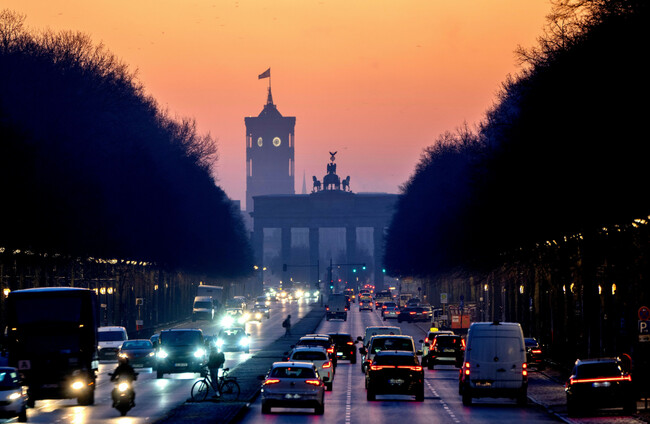
Cars move towards the Brandenburg Gate in Berlin Alamy Stock Photo

German election: Huge turnout, young voters turn left and former Soviet east backs the far right

The election saw a massive turnout of 82.5%, the highest since Germany was reunified in 1990.

VOTING IN THE German general election yesterday turned up some striking results, including a clear division along the line that divided the country up until the fall of the Berlin Wall in 1989.

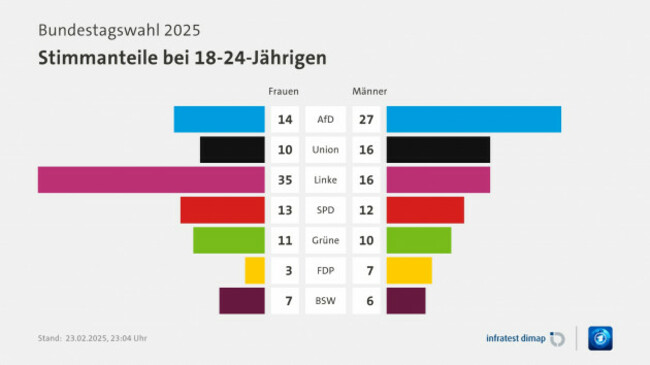
Results from the election also show that more young men voted for the right while young women favoured the left.

The election also saw a massive turnout of 82.5%, the highest since Germany was reunified in 1990. 

‘Unusually toxic’

Dr Matthias Dilling, assistant professor in political science at Trinity College Dublin, told The Journal that the high turnout indicated an understanding among the German public that “this was an important election”. 

Dilling also said that the campaign was particularly polarised and “unusually toxic”, especially when candidates clashed over approaches to immigration. “The debate over migration and Merz’s break of a post-war taboo by accepting AfD support to pass a non-binding motion on stricter migration policies earlier this year also likely had a mobilising effect.”

While the conservative CDU/CSU alliance, or Union, led by Friedrich Merz won 28% of the votes over the weekend, according to projections, the result that has caught many observers’ attention was the strong performance of the far-right, anti-immigration Alternative for Germany party (AfD). 

Merz proposed a motion in parliament ahead of the election calling for many more migrants to be turned back at the border, which was passed with the support of the AfD.

That move was widely criticised as a breach of a longstanding policy among all other political parties to not cooperate with the far right. It also does not seem to have had the effect Merz intended as his party did not appear to pick up votes from would-be AfD supporters. 

As Dilling said, the turn to the right was “not a vote getter” and that there “needs to be some soul-searching on how to respond to the far right”. 

The AfD almost doubled its percentage of votes in this election, receiving 20% support, although a strong return had been predicted as immigration came to dominate the run-up to the vote, especially in the wake of multiple attacks on civilians blamed on asylum seekers and refugees in recent months. 

The Social Democrats (SPD) of outgoing Chancellor Olaf Scholz were left with a historically low number of votes, garnering the support of just 16% of those who went to the polls. 

The Left Party surprised some observers with a strong return of 8.8% support, with much of that coming from younger voters. 

Geographical divide

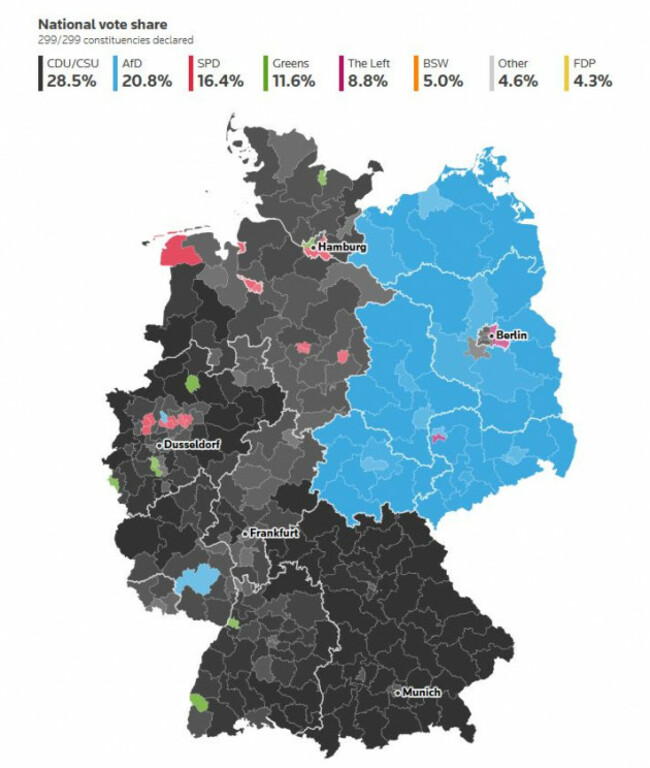
The AfD emerged as the strongest party across the country’s formerly communist and historically less prosperous east, a result that has cemented its dominance in a region that has long been a stronghold, and where it won its first state election last year.

Other parties were stronger in only a few eastern constituencies outside Berlin.

In western Germany, which accounts for most of the country’s population, AfD trailed Merz’s alliance and in some cases other parties too, but still polled strongly on its way to a record haul of votes across the country.

Germany map election A map showing party votes by constituency Reuters Reuters

Dr Matthias Dilling of Trinity College Dublin said that the AfD’s strong performance “confirms a pattern of previous elections” that can be attributed to a number of factors.

The reasons behind the appeal of the far right in the east form a “complex picture”, which includes the poorer state of the economy there as well as dissatisfaction with public services. 

Differing memories of the past, which continue to shape conceptions of modern day German 35 years after reunification, also play a role, Dilling said. 

“Disillusion is a factor,” he said, adding that the support for the far right in the east is “not merely a protest vote” but an indication that nativist politics has more of a hold in the former Soviet-controlled part of the country. 

Dilling also said that the AfD “tapped into existing grievances” and managed to connect those grievances with the party’s core issues. 

Left Party comback 

While AfD made the biggest gains, the Left Party (Linke) also did very well, especially among young voters. 

The party appeared headed for electoral oblivion at the start of the campaign but pulled off a resounding comeback to take 8.8% of the vote.

The Left Party appealed to young voters with very liberal positions on social and cultural issues, as well as its approach to immigration and a tax-the-rich policy.

For Dilling, the appeal of leftwing policies is “not uncommon” among young voters, but the boost the Left Party received can also be attributed to a decline in support for the three outgoing coalition parties. 

He also said the party had “a particularly sophisticated social media campaign”. 

Gender differences among young voters

Another striking aspect of the way the voting broke down was a clear preference among young women for parties of the left while young men accounted for many votes won by the far right. 

Gender breakdown Germany Voting shares among 18-24-year-olds in the German election Tagesschau Tagesschau

Among male voters aged between 18 and 24, 27% voted for the Afd whereas 14% of women in that age bracket gave the far-right party their vote. 

The result was almost the inverse for the Left Party, Linke, which got 35% of young women’s votes but just 16% among young men. 

Dilling said the conventional wisdom among political analysts is that support for far-right parties is often driven by men. 

He also said that part of the reason for the AfD doing well among young men could be put down to the “cultural backlash” in right-wing politics regarding advances made in the area of women’s rights and social standing. 

He said the far right in Germany promotes a “fairly typical” right-wing position that argues for traditional gender roles and claims men’s rights have been eroded. 


With reporting from Press Association  

Readers like you are keeping these stories free for everyone...
A mix of advertising and supporting contributions helps keep paywalls away from valuable information like this article. Over 5,000 readers like you have already stepped up and support us with a monthly payment or a once-off donation.

Close
106 Comments
This is YOUR comments community. Stay civil, stay constructive, stay on topic. Please familiarise yourself with our comments policy here before taking part.
Leave a Comment
    Submit a report
    Please help us understand how this comment violates our community guidelines.
    Thank you for the feedback
    Your feedback has been sent to our team for review.

    Leave a commentcancel

     
    JournalTv
    News in 60 seconds