Sign in. It’s quick, free and it’s up to you.
An account is an optional way to support the work we do. Find out more.
Sign in. It’s quick, free and it’s up to you.
An account is an optional way to support the work we do. Find out more.
LAST UPDATE | 30 Aug
ICELAND HAS VOTED against resuming membership talks with the European Union.
The country went to the polls on Saturday, with around 270,000 eligible voters asked to answer “Yes” or “No” to the question: “Should Iceland resume accession negotiations with the European Union?”
The final result, published by public broadcaster RUV, shows that 52.8% voted ‘No’ compared to 47.2% for the ‘Yes’ camp.
Some 225,031 votes were cast, resulting in a voter turnout of 82.5% – the highest in any Icelandic election since the parliamentary election in April 2009.
The close result will be a disappointment to Brussels, which had appeared willing to compromise on thorny issues to facilitate Iceland’s accession.
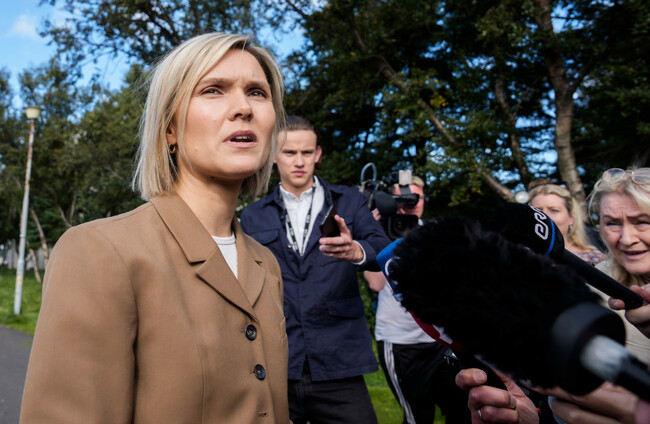
At a press conference this afternoon, Social Democratic Prime Minister Kristrún Frostadóttir, who favoured a ‘Yes,’ stressed that she didn’t “see this as a setback.”
“I see this as a victory for democracy,” she said, citing the high voter turnout.
“I want to make it absolutely clear, this government is not going forward with the accession talks this term.”
Any discussions on EU question in Iceland will now be frozen until at least 2028, when the current government’s term ends.
Iceland is already a member of the European Economic Area and the free-movement Schengen zone – ties which will remain unchanged regardless of the referendum outcome.
The country of just under 400,000 applied to join the EU in 2009, a year after the 2008 financial crisis led to the collapse of its banks and economy.
Membership negotiations began in 2010 but were suspended in 2013 after a eurosceptic government came to power, and formally came to an end in 2015.
“I’m maybe in a kind of denial that this has happened. It’s hard to grasp that it’s a ‘No’,” 37-year-old artist Elisabet Anna Kristjansdottir told AFP.
“It’s quite sad that the Icelandic people don’t even want to see the possibilities of joining the EU.”
Anna Maria Bogadottir was of the opposite opinion. She was “really happy”, but acknowledged it would now “be a challenge to unite 50% on each side.”
Debates throughout the campaign mainly revolved around domestic and economic issues, even if rising international tensions, with the war in Ukraine and US President Donald Trump’s ambitions for neighbouring Greenland, have featured in discussions.
The campaign had “lifted discussions about the EU, about Iceland’s place in the world, about our general geopolitical situation and status, to a higher level”, Frostadóttir said on Saturday after she cast her ballot.
The government had said that in the event of a ‘No’, it would leave to parliament the question of whether or not to formally withdraw the country’s EU membership application.
Had the ‘Yes’ side been successful, an accession agreement would have been negotiated with Brussels and then put to a new referendum on actual membership.
The issue of fisheries – a pillar of Iceland’s economy and over which Reykjavik wants to retain exclusive control – would had to have to be hammered out with Brussels.
Any accession agreement would have then been put to a new referendum in Iceland.
The fisheries sector has been fiercely opposed to joining the bloc – 90% of companies in the industry are against the idea – and the EU had tried to woo them with a conciliatory approach ahead of the vote.
“Iceland’s unique specificities on fisheries and agriculture are well known. They would have to be carefully considered,” EU Enlargement Commissioner Marta Kos had said.
“I’m confident that, together with EU member states, we would find creative solutions.”
An EU source in Brussels told AFP: “I don’t think anyone (in the EU) wants to block an accession over a question of fish.”
Iceland’s economy has recovered since 2008 and is now thriving.
But its currency is volatile, and the flip side of its newfound prosperity is soaring inflation and interest rates, leaving many indebted Icelandic households glancing longingly at the prospect of adopting the euro and its lower interest rates.
On the global stage, the return of war in Europe with Russia’s invasion of Ukraine has shaken established security doctrines.
Iceland is an island strategically located in the sub-Arctic. It has no military and depends on Nato and a 1951 bilateral agreement with the United States for its defence.
Trump’s unpredictability and his threats to take over neighbouring Greenland – which he has mixed up with Iceland on several occasions – have added to Icelanders’ concerns.
With reporting from © AFP 2026

To embed this post, copy the code below on your site












have your say