We need your help now

Support from readers like you keeps The Journal open.

You are visiting us because we have something you value. Independent, unbiased news that tells the truth. Advertising revenue goes some way to support our mission, but this year it has not been enough.

If you've seen value in our reporting, please contribute what you can, so we can continue to produce accurate and meaningful journalism. For everyone who needs it.

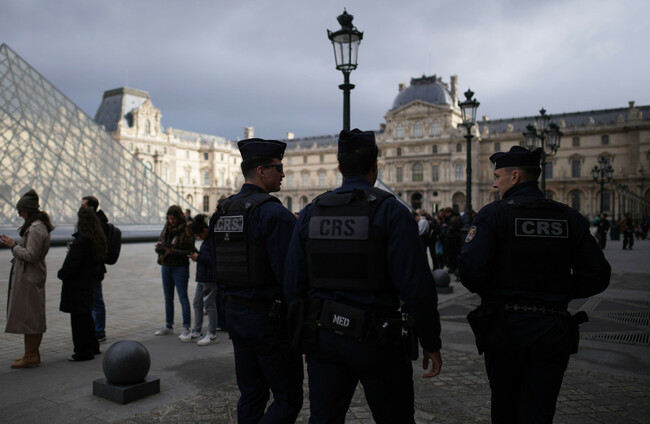
Riot police officers patrol as people queue to enter Le Louvre museum Monday, 27 October in Paris. Alamy Stock Photo

Two Louvre heist suspects ‘partially’ admit participation, says Paris prosecutor

It took thieves less than eight minutes to steal the jewels valued at €88m from the world’s most visited museum.

THE SUSPECTS IN the Louvre jewel heist have “partially” admitted their participation and are believed to be the men who forced their way into the world’s most visited museum, a Paris prosecutor said.

Laure Beccuau told a news conference that the two face preliminary charges of theft committed by an organised gang and criminal conspiracy, and are expected to be held in provisional detention.

She did not give details about their comments.

It took thieves less than eight minutes to steal the jewels valued at €88m on 19 October, shocking the world.

The thieves forced open a window, cut into cases with power tools and fled with eight pieces of the French crown jewels.

One suspect is a 34-year-old Algerian national who has been living in France since 2010, Beccuau said.

He was arrested on Saturday night at Charles de Gaulle airport as he was about to fly to Algeria with no return ticket.

He was living in Paris’s northern suburb of Aubervilliers and was known to police mostly for road traffic offences, Beccuau said.

The other suspect, 39, was arrested on Saturday night at his home in Aubervilliers.

“There is no evidence to suggest that he was about to leave the country,” Beccuau said.

The man was known to police for several thefts, and his DNA was found on one of the glass cases where the jewels were displayed and on items the thieves left behind, she added.

Prosecutors had faced a late deadline today to charge the suspects, release them or seek a judge’s extension.

The jewels have not been recovered, Beccuau said.

“These jewels are now, of course, unsellable… Anyone who buys them would be guilty of concealment of stolen goods,” she warned.

“It’s still time to give them back.”

Earlier today, Paris police acknowledged major gaps in the Louvre’s defences – turning the dazzling daylight theft into a national reckoning over how France protects its treasures.

Paris police chief Patrice Faure told Senate legislators that ageing systems and slow-moving fixes left weak seams in the museum.

“A technological step has not been taken,” he told legislators, noting parts of the video network are even still analogue, producing lower-quality images that are slow to share in real time.

A long-promised revamp – a $93m (€79m)project requiring roughly 60km of new cabling – “will not be finished before 2029–2030″, he said.

Faure also disclosed that the Louvre’s authorisation to operate its security cameras quietly expired in July and was not renewed – a paperwork lapse that some see as a symbol of broader negligence.

“Officers arrived extremely fast,” Faure said, but he added the lag occurred earlier in the chain – from first detection, to museum security, to the emergency line, to police command.

Faure and his team said the first alert to police came not from the Louvre’s alarms but from a cyclist outside who dialled the emergency line after seeing helmeted men with a basket lift.

The theft has also exposed an insurance blind spot: officials say the jewels were not privately insured.

The French state self-insures its national museums, because premiums for covering priceless heritage are astronomically high – meaning the Louvre will receive no payout for the loss.

The financial blow, like the cultural wound, is total.

Faure pushed back on quick fixes.

He rejected calls for a permanent police post inside the palace-museum, warning it would set an unworkable precedent and do little against fast, mobile crews.

“I am firmly opposed,” Faure said.

“The issue is not a guard at a door; it is speeding the chain of alert.”

He urged legislators to authorise tools currently off-limits: AI-based anomaly detection and object tracking (not facial recognition) to flag suspicious movements and follow scooters or gear across city cameras in real time.

The 19 October heist was swift and simple.

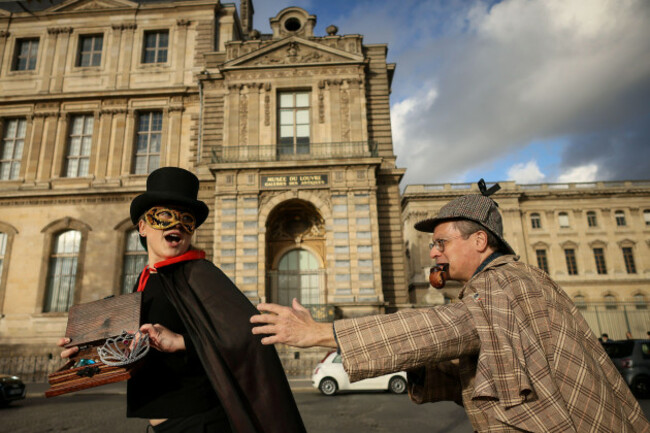
members-of-the-paris-holmes-society-cercle-holmesien-de-paris-laurence-deloision-dressed-like-arsene-lupin-left-and-thierry-gilibert-dressed-like-sherlock-holmes-stage-the-theft-by-the-facade Members of the Paris Holmes Society (Cercle Holmesien de Paris), Laurence Deloision, dressed like Arsene Lupin, left, and Thierry Gilibert, dressed like Sherlock Holmes, stage the theft by the facade and the window where thieves entered the Louvre museum, 25 October in Paris. AP Photo / Thomas Padilla AP Photo / Thomas Padilla / Thomas Padilla

In the morning rush, thieves reached the jewel gallery near streetside windows, cut through reinforced cases and vanished in minutes.

Former bank robber David Desclos told The Associated Press the operation was textbook and vulnerabilities were glaringly obvious in the layout of the gallery.

Culture minister Rachida Dati, under pressure, has stayed defensive – refusing the Louvre director’s resignation and insisting alarms worked while acknowledging “security gaps did exist”.

She has kept details to a minimum, citing ongoing investigations.

The reckoning lands at a museum already under strain.

In June, the Louvre shut in a spontaneous staff strike – including security agents – over unmanageable crowds, chronic understaffing and “untenable” conditions.

Unions say mass tourism and construction pinch points create blind spots, a vulnerability underscored by thieves who rolled a basket lift to the Seine-facing facade and reached a hall displaying the crown jewels.

Faure said police will now track surveillance-permit deadlines across institutions to prevent repeats of the July lapse.

But he stressed the larger fix is disruptive and slow: ripping out and rebuilding core systems while the palace stays open, and updating the law so police can act on suspicious movement in real time – before a scooter disappears into Paris traffic and diamonds into history.

Experts fear the stolen pieces may already be broken down and stones recut to erase their past – a prospect that adds urgency to France’s debate over how it guards what the world comes to see.

Close
10 Comments
This is YOUR comments community. Stay civil, stay constructive, stay on topic. Please familiarise yourself with our comments policy here before taking part.
Leave a Comment
    Submit a report
    Please help us understand how this comment violates our community guidelines.
    Thank you for the feedback
    Your feedback has been sent to our team for review.

    Leave a commentcancel

     
    JournalTv
    News in 60 seconds