Sign in. It’s quick, free and it’s up to you.
An account is an optional way to support the work we do. Find out more.
Sign in. It’s quick, free and it’s up to you.
An account is an optional way to support the work we do. Find out more.
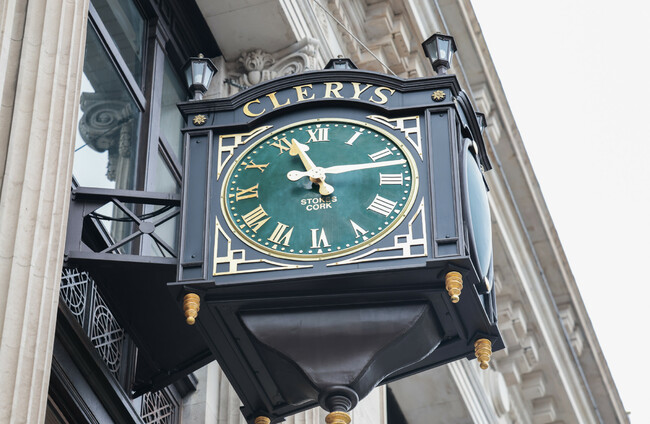
MATHS WEEK is under way and, as is our annual tradition, we’re setting our readers some puzzles every night. Give them a go!
Today we have some puzzles about time and clocks. There is a long association between mathematics and the measurement of time. We mark time in minutes and seconds, which are counted in sixties. This has its roots in the maths of the Babylonians who used a base 60 number system. Angles are measured in degrees and there are 360 degrees in a complete rotation.
A degree is divided into 60 minutes and a minute into 60 seconds.
The development of the mechanical clock in medieval Europe had an important influence on mathematics. Mathematics helped engineers make better clocks and the clocks helped mathematicians and scientists explore motion and make more accurate astronomical observations.
So, if you’ve the time have a go at these:
1) On an analogue clock what is the angle between the hour hand and the minute hand at 9 o’clock?
2) On an analogue clock what is the angle between the hour hand and the minute hand at 11 o’clock?
3) On an analogue clock, what is the angle between the hour hand and minute hand at 11:45?
4) A clock gains 10 minutes every hour (of real time). It is set at the correct time at 12 noon. What time does the clock display when the correct time is 6pm?
5) A clock gains 10 minutes every hour (of real time). It is set correctly at 12 noon. What is the correct time when the clock shows 6 pm?
6) A clock runs fast, but in a very strange way. Between 1 o’clock and 2 o’clock on its display, it runs at the correct speed. Between 2 o’clock and 3 o’clock, it runs at twice the correct speed. Between 3 o’clock and 4 o’clock, it runs at three times the correct speed, and so on. If the clock is set correctly at 1 o’clock, what will the actual time be when it displays 6 o’clock?
1. Mark the rope into lengths of 3, 4 and 5 metres.
Tie the rope into a loop and stretch it taut to form a triangle with sides of 3, 4 and 5 metres. This will be a right angled-triangle and the angle between the 3m and 4m will be a right angle. This technique has been used in surveying and construction for centuries.
2. You walk 500m East and 1,200m North. Turning from East to North is a right angle.
We therefore need to calculate the long side.
First find the sum of the squares on the smaller two sides:
500² + 1200²
250,000 + 1,440,000 = 1,690,000
√1690,000 = 1,300
You would be 1,300m or 1.3km from where you started.
3. Diagonal of the TV is 30 inches, the width is 24 inches. This is a right-angled triangle. If we use H to represent the height, we can write:
24² + H ²= 30²
576 + H² = 900
H² = 900 – 576
H² = 324
H = 18 (as 18×18 = 324)
So height is 18 inches.

To embed this post, copy the code below on your site














have your say