Sign in. It’s quick, free and it’s up to you.
An account is an optional way to support the work we do. Find out more.
Sign in. It’s quick, free and it’s up to you.
An account is an optional way to support the work we do. Find out more.
LAST UPDATE | 22 hrs ago
SCRAMBLER, E-SCOOTER AND e-bike related injuries are rising at an “exponential rate” and placing a “huge burden” on an already overstretched system, emergency doctors have said.
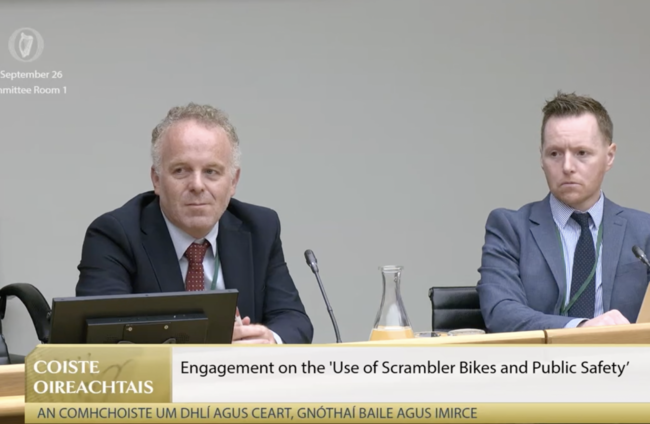
Two consultants in emergency medicine and trauma at the Mater hospital in Dublin told the Oireachtas justice committee today that presentations there for injuries related to these electric vehicles have been steadily rising over the last two years.
E-scooter related injuries have risen from 173 in 2021 to 309 last year. E-bike related admissions are even higher, more than doubling from 53 in 2024 to 115 in 2025. In the first half of this year alone, 76 people have presented to the Mater’s A&E following an e-bike related incident.
Of 380 patients who presented to the Mater between July 2021 and June 2023 with injuries related to e-scooters, 11.3% needed an operation, 11 had bleeding on the brain, and two needed emergency neurosurgery.
This amounted to a total of 3,000 hours spent by patients in the Mater’s trauma department, with 300 days as admitted inpatients.
“It’s a huge part of our workload that they’re causing,” Dr Shane Broderick, consultant at the Mater, told the committee.
“We’re already stretched. We’re already busy. We’re already busy from a trauma point of view, and there’s no doubt that these numbers are rising at an exponential rate for us, and it’s stretching an already-overstretched system.”
Part of the issue, both consultants said, was the lack of a standardised system to be able to document the profile of those injured, including the type of vehicle, the age of the person, whether they were driving legally, and whether they were wearing protective equipment.
This contributes to a lack of extensive data, which varies depending on who collects it – be it the Road Safety Authority, the Central Statistics Office, An Garda Síochána, or the hospitals themselves.
Dr Luke Phillips, also a consultant at the Mater, said that major trauma incidents are taking up a lot of the department’s resources.
If a person came off their bike with major injuries, that’s a team of about three or four doctors, and at night time, that’s our whole emergency department.
“In terms of the NCHDs (non-consultant hospital doctors) that are there, and then it takes about three or four nurses plus radiology inpatient teams, and some of them need to go into emergency theatre.
“That probably cancels out like theatre for the next day sometimes because of surgeons being in the middle of the night, so there’s a lot of downward stream effects that happen in hospital when these patients come in.”
Broderick emphasised that changes need to be made to Ireland’s trauma system.
“The initial steering document, the trauma strategy for Ireland, was published in 2018, and it is being delivered, but on a very, very piecemeal, what we feel is probably too slow a basis,” he said.
He gave the example of London, which reduced trauma deaths by 50% in five years.
“Now we’re eight years into our trauma system… If that was implemented and we were fully resourced to do the job that we want to do, then we can see those figures as well.
“The blueprint is there, but it’s got to be given more emphasis. I think that an opportunity was missed and not included as part of the Critical Infrastructure Bill in 2026. I think that the focus was on other areas, and not on health.”
When asked what a trauma system should look like, he said that it needed to be one where the “right person goes to the right hospital at the right time the first time”. It involves pre-hospital protocols, to ensure that a patient is sent to the right hospital, adequate resourcing, and post-hospital rehabilitation.
According to Broderick, e-scooters are now the leading cause of paediatric brain injury admission to the national neurosurgical centre, with 18 children admitted last year, an increase of 50%.
Between July 2021 and June 2023, 30 children were admitted to the Mater with an e-scooter brain injury. The vast majority had a skull fracture, and nearly half needed intensive care and emergency brain surgery.
In these cases, the average stay in hospital is just under three weeks. 40% of children have cognitive difficulties a month later.
While scrambler incidents are less frequent so far, the nature of the injury is often more serious. Over a quarter of people who present to A&E with injuries caused by scramblers were admitted to hospital for further treatment including operations, critical care, or rehabilitation.
Injuries include limb fractures, spinal fractures, and organ injury, such as to the spleen and liver, and severe traumatic brain injury.
Broderick said that many of the people that they see with scrambler related injuries are young and very small. Scramblers can weigh up to 200kg, he said, which is one fifth of the weight of a car.
Riders will often have no driving licence, and no idea of the rules of the road.
He said that they are often so small that “you wonder can they even lift the bike?”
“The margin for error is not there,” he said, adding that there would be “no way you would have the balance, wherewithal, or the cognition” if another driver were to pull out in front of you.
He said that he had seen cases where the person was so small that Dublin Fire Brigade didn’t have the right size of equipment to be able to care for that person.
Following the rise in children being admitted to hospital with severe brain injuries, the government discussed banning the use of e-scooters for under 18s.
The regulations, which were announced today, will raise the age limit from 16 to 18.
Fees for storage of seized e-scooters will also rise to €80 for detention and the first day of storage, and will be €30 for each additional day of storage.
These changes will take effect from 2 October.
These regulations follow recent changes making helmets and high-visibility clothing mandatory for e-scooter users since 4 September.
In April, Grace’s Law came into effect, which bans the use of scrambler bikes and quad bikes in public places. It was named after Grace Lynch, who was killed by a scrambler bike in Finglas, Co Dublin in January this year.
Phillips told the committee today that, while they welcome Grace’s Law, they are also recommending further legislation, including banning the import and sale of these vehicles, mandatory vehicle registration, and “real enforcement” of age limits and the use of protective equipment.
But there are concerns that this is not enough. Paula Butterly, deputy chair of the justice committee, told The Journal that tackling the use of e-scooters and associated vehicles involves a “multi-faceted approach”.
There’s never one solution to one problem… parents have to take a certain sense of responsibility here. At the end of the day, not very many children… are in a position to go in and buy these scooters or scramblers for themselves.
She also said that there is an “absolute need” for a programme to be rolled out in schools to make children aware of the dangers of e-scooters, e-bikes and scramblers.
As Broderick told the committee, “the law only as good as it is enforced, otherwise it is lip service”.
To embed this post, copy the code below on your site













have your say