Sign in. It’s quick, free and it’s up to you.
An account is an optional way to support the work we do. Find out more.
Sign in. It’s quick, free and it’s up to you.
An account is an optional way to support the work we do. Find out more.

In Calling 353, bestselling Motherfoclóir author and podcaster Darach Ó Séaghdha casts a linguistic eye on how we talk about what it means to be Irish, the signs we post to each other about Irishness – and what really lies beneath it all.
SOME OF THE starkest differences between Ireland and our next-door neighbours become visible to the naked eye at this time of year. While Hallowe’en has now taken root in England, their winter evening for bonfires and fireworks is still Guy Fawkes Night which is not celebrated in Ireland (except by me, because it’s my birthday).
And if you were to visit one of those effigy-burning parties in England, you might notice that many attendees would be wearing a sort of plastic badge which you would rarely see in the Republic.
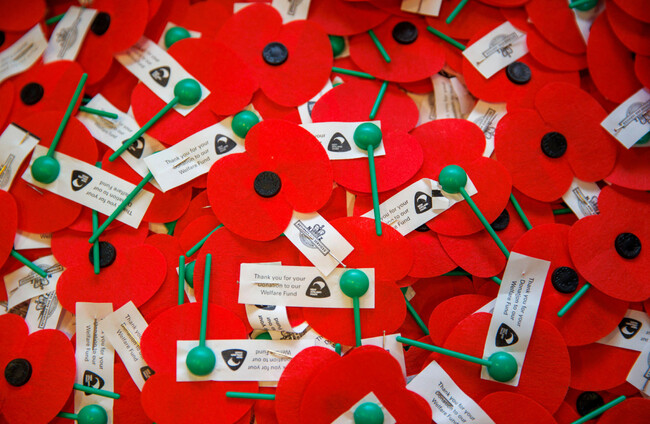
In 1921 the British Legion – impatient with the British government’s refusal to make a decision on how Armistice Day would be observed (along with a list of related issues) – decided to sell “Flanders poppies”, little artificial replicas of the flower which grew so abundantly in the Belgian battlefields.
The Daily Mirror noted that year that “the making of these flowers is providing work for many in the devastated areas, and their sale on Remembrance Day will be for the benefit of those who fought, but who are now workless and financially distressed in the land that they fought for”. Their poppy campaign had another angle – visitors to the Cenotaph who would ordinarily leave wreaths or flowers sold by hawkers nearby, were encouraged to buy a poppy to help distressed veterans instead.
You could argue that the poppy campaign began as a kind of protest against the State’s reluctance to help veterans conscripted into the most vicious war the world had ever seen. And while many people in Britain, including some of those who served, had different views as to whether the Great War was a worthwhile project, the idea that those veterans whose lives had been shattered needed help was not divisive. Canada, America and France had already run similar initiatives for veterans.
Readers of Irish history, however, will see the 1921 date and do some quick sums in their heads.
The remembrance poppy, from the moment of its inception, included soldiers whose guns were pointed at Irish people. It has never not included them.
A lot has happened in the hundred years and more since, and a strange culture of wearing and not wearing poppies has emerged. The establishment of the NHS, National Insurance and various other social supports for the general population – as well as the end of conscription and an improvement in remuneration for soldiers themselves – has meant that the Poppy Appeal isn’t as urgent as it once was.
And as veterans of the Great War gradually became outnumbered by people born after the conflict, and then by veterans of other conflicts, the significance of the little flower became muddled. The last British veteran of the First World War died in 2012, and this moment – when the wearing of the poppy broke its last direct connection to the war and aftermath that led to it – may have been when poppy lunacy fully ran riot.
Poppies on the jerseys of soccer players, introduced tentatively after the invasion of Iraq (there was initially a bit of reluctance concerning the optics of a “with poppy” team playing against a “without poppy” team) went from jarringly new to automatically expected – even by teams with red jerseys.
Was the poppy ever intended for wear during exercise?
While a relatively normal English person might wear a poppy on her coat and hang this up while indoors, the rehearsal videos in Strictly Come Dancing imply that it is normal to wear a poppy on one’s gym gear while practicing a carefree, silly charleston or an intense, sensual rhumba. Its rival autumnal comfort TV series, the Great British Bake Off, has managed to avoid being sucked into the poppy discourse by being filmed in the summertime.
Newscasters and footballers have been criticised for declining to wear one, most famously Ireland’s James McClean. Channel 4’s John Snow made the reasonable point that as a journalist he might be expected to present stories critical of the military or the British Legion and wearing a poppy could be seen as showing a bias, for all the good it did him.
A viral clip from CBBC in which broadcaster Lauren Layfield is unable to restrain her laughter at her co-host’s remark that “we’re just normal men” is made all the odder by the fact that her co-host is a puppet, and that puppet (Hacker T. Dog to you) is wearing a poppy.
England was once peppered with signs saying “No blacks, no dogs, no Irish”, but times have changed and now dogs are very welcome, as a comparative study of the poppy appeal with other charities shows.
If Poppymania in Britain has led to first principles being forgotten, it may also have led to second and third principles going out the window too. The Royal British Legion have stated that the gesture is meaningless if it is coerced. Unofficially, they have muttered that the terror certain public figures feel about being spotted without a poppy has led some people to reuse last year’s one instead of buying a new one, leading to less dosh for the charity itself.
In 2025, the Royal British Legion came 65th in the ranking of UK charities – behind the RSPCA (in 63rd place), the Dogs Trust (in 61st place) and way behind Islamic Relief Wordwide in 40th place and the under-fire RNLI in 30th place. If any other charity was allowed to run a two-week multi-channel telethon where non-participants could be threatened and humiliated, it is likely that they would do better.
And then there’s the Purple Poppy, worn by those who wish to commemorate the patriotic animals who died in wars – the horses, dogs, carrier pigeons, dolphins and other beasts who made the ultimate sacrifice. For some people this might be a poppy too far – if a pigeon had a strong opinion on the assassination of an archduke who loved shooting birds and other wildlife, it was probably an approving one. Sellers of red and white poppies (who don’t especially like each other) have expressed their displeasure at the arrival of this third kind, especially when animal charities already do so well in England.
Since the presidency of Mary McAleese, there have been attempts to re-examine Ireland’s relationship with the Great War, to make amends for the bad treatment of soldiers returning from that conflict as well as to better understand the significance of the Somme for Ulster Protestant communities. And while these are both honourable endeavours, it is unlikely that poppy-wearing by Irish public figures will do anything to advance them.
However, if you are absolutely determined to wear a poppy in Dublin, there is a place in town where you can find them if you don’t have an inside connection in the British Army. Just make your way to the Freemasons Lodge on Molesworth Street to get yourself fitted – they do them there.
Darach will be back next Sunday with more thoughts on the words and Irish cultural phenomena that unite us.
To embed this post, copy the code below on your site









have your say